Screams from the Dusty Victorian


Lovely garden spider making its home under the ledge of my recycling box. It appears to be snacking on a fly. Good girl.


Now that autumn is upon us and the nights are much cooler, blood curdling screams have been heard from the Dusty Victorian. The bugs are coming in for a little bit of warmth, I guess - and if they are not in, they are at the windows or the doors, wanting to come in. You see, my daughter has an almost phobic fear of bugs (I don't know where she got that from.....ahem). Her clear, glass shattering, soprano scream can be heard by the neighbours, I'm sure. But I wouldn't know anymore because she's rendered me deaf.

Beautiful moth, but I don't like it when it thinks my face is the moon. Wouldn't that pattern make for a beautiful sweater?

House centipede in our hallway.

I have to admit that the house centipede is pretty horrifying. I had never seen one before moving to Ontario. In the three years we've lived at the DV, I've only seen this creature twice and both times were in autumn. I'm told that they are more commonly seen in old homes because of damp, creepy basements (which is certainly what we have). After researching this insect, I find there is nothing much to worry about; it's quite the scaredy cat when it comes to humans.

It's so fast it's hard to catch - but I succeeded and outside it went. I only kill in self defense, but flies and mosquitos are fair game year round.

This guy came in soon after I had cracked a window open. I had never seen this bug before and was unsuccessful in trying to identify it. It has a nice pattern on its back that looks like an African warrior's shield. If anyone can identify it, please let me know.

This grasshopper was huge and if you look closely, it appears like it's looking at me while taking its picture. I think grasshoppers are pretty cool.

This Daddy Long Legs was on the verge of coming in. It had a circumference of about 5".

This variety of house spiders is the most commonly seen in our home, not just in autumn, but year round. They are unbelievably passive.

My daughter lived most of her life in Vancouver, in a condominium on the 7th floor where insects were a rare occurrence. Now that we live in Southern Ontario, in a small town surrounded by woods and farmland, rarely does a day go by without hearing a gasp, a scream or a "what the hell is that?!"

Victorian Building Blocks - Part II


The first settlers arrived in St Marys in the early 1840s, attracted by the area’s natural resources. At the new town site, the Thames River cascaded over a series of limestone ledges, providing the power to run the first pioneer mills and giving the community an early nickname: Little Falls.

In the riverbed and along the banks, limestone was close to the surface and could be quarried for building materials. Today, this area of the river bed is used for play and fishing. On a hot summer's day, kids are found frolicking in water that only barely reaches their knees.

Many 19th-century limestone structures survive: churches, commercial blocks, and private homes. They've given St. Marys its current nickname: Stonetown.

Our neighbor's house


The Library and City Hall

One of the numerous bridges in St Marys, with our swans.

You would think you're in England.

Victoria Bridge, our main bridge off of Queen Street which goes over the river Thames. Although always shallow, here the river bed is exposed almost to the middle. These two dogs don't seam to mind.

Although the Dusty Victorian's walls are made of brick, its foundation is made of limestone blocks from the first local quarry. In my opinion, what makes limestone so interesting are the ancient marine organisms, still visible in the cut stones.

The following are photographs of fossils in the limestone that was used in walls, bridges, the library and, of course, the DV's foundation.

Little ancient creatures embedded in the foundation blocks of our home.

Sea sponge

To me, this looks like a coral reef with its fan coral surrounded by sea shells.

Jelly fish

Shrimp

This sea shell felt as smooth as polished marble.

This little conch looks like a tuque; could be inspiration for a knit designer.

Muscle

Sea food bouillabaisse

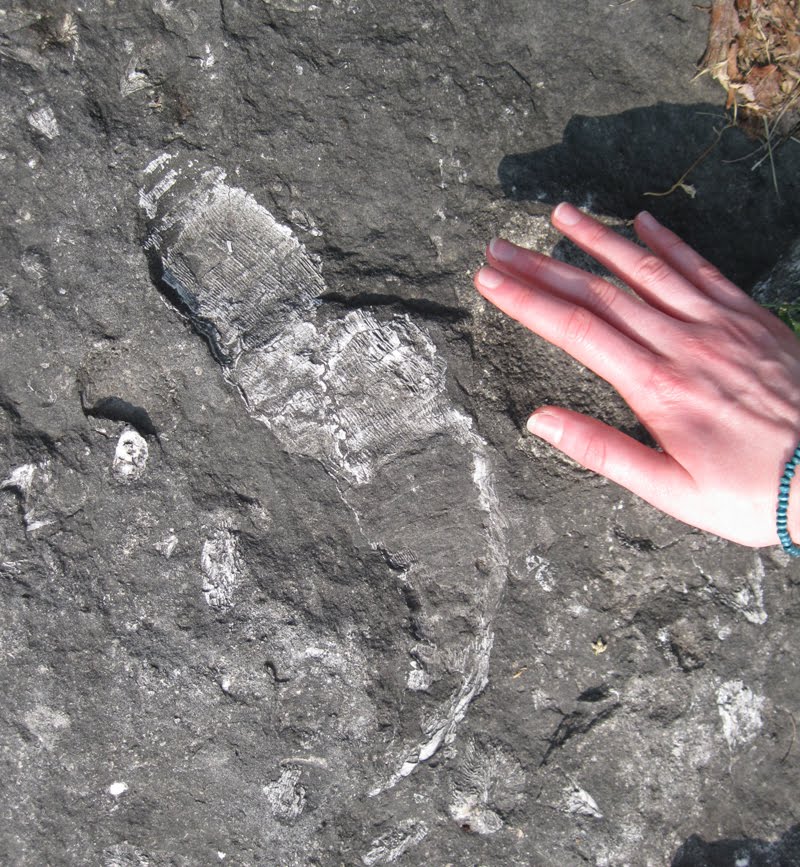
A big fossilized thing. Astrid's hand is used as size reference. To me it looks like a tusk, perhaps from a prehistoric walrus - I don't know. It looks like its resting on a clam.

My best find is this fossilized print, which looks like a claw. Brian thinks I have an overactive imagination, but who knows what gifts ancient glaciers left us when passing through St Marys.

Victorian Building Blocks


One summer, my brother-in-law Peter pointed out a little paw print imbedded on the surface of a brick of the back wall of our house. This led to the discovery of numerous “imperfections” in the bricks and the realization that no two bricks on our house were the same. The bricks of the Dusty Victorian look very weathered with their uneven colouring, pockmarks, scratches, waves and ripples, but what is most interesting are the prints left by the workers and animals of the time.

In the nineteenth century brick making was an occupation at the absolute bottom of the ladder, associated with the most degrading poverty. The work was low skilled and seasonal. I think the bricks on our house is a testimonial of that hardship.

Look closely.


Raccoon or cat prints.


Testing with his finger to see if the clay was ready.

Grabbing the brick, thinking it was firm enough to handle. Four finger tips, from the index to the pinky. The thumb print is probably on the inside of the wall.

Don't know what these numbers mean. They are quite high up on the wall.

These angled prints were numerous all over. I think they are prints of other bricks from stacking.

I'm not sure what that print is, but if I let my imagination run free, I would say that this brick was made in autumn and a leaf fell on wet clay. The worker grabbed the stem, leaving behind
his clumsy prints.

This is a relatively recent print of the boy who lived here before us. Love it.

More on Victorian brick making can be found at this site.